Designing Growth, Not Assembling It
Most companies don't design their go-to-market engines — they assemble them. A team here, a tool there, a process borrowed from someone else's playbook. The result? GTM motions that are bloated, misaligned, and stall as they scale.
Yet, there are ways to do better. Designing your approach — instead of relying on ad-hoc build-ups — yields outcomes that are predictable, repeatable, and scalable.
One such framework is Winning by Design's Revenue Architecture, which brings a structured, engineered mindset to how businesses build and manage their revenue systems. Originally developed with Enterprise SaaS in mind, it offers a blueprint for designing operations-mapping customer journeys that drive sustainable growth.
But frameworks alone don't grow revenue — they need to be applied with judgment. And as we'll see, Revenue Architecture's principles reach far beyond SaaS, offering valuable lessons for any business serious about scaling with intent.

Revenue Architecture TL;DR
Revenue Architecture offers a simple blueprint for building predictable, scalable revenue systems — not by chance, but by design.
| Revenue Architecture (Winning By Design) | |
|---|---|
| What it is | A framework developed by Winning by Design that treats revenue generation as a scientific, system-engineering problem rather than a sales artform. |
| Why it matters | In complex, recurring revenue businesses, random acts of marketing, sales, and customer service no longer cut it. Growth today demands structured customer journeys, repeatable processes, and leading indicators — all orchestrated around customer impact. |
| Key Principles at a Glance |
|
Bottom line: Revenue Architecture turns growth from a best-effort activity into a designed system — creating the conditions for sustainable, repeatable success.
Applicability Beyond SaaS
Revenue Architecture was born in the world of Enterprise SaaS — a sector obsessed with scaling recurring revenue models and optimizing customer lifecycles.
But its core principles — designing structured, system-driven customer journeys — extend far beyond software.
In fact, any business that relies on complex buying journeys, long-term customer relationships, or recurring customer impact can benefit. Here's why:
- Complexity isn't unique to SaaS. Industrial B2B companies, professional services, and even advanced B2C businesses (think subscription models) face long, multi-touch customer lifecycles that demand structure.
- Retention and expansion matter everywhere. Whether selling industrial machinery with service contracts or financial advisory services — loyalty and recurring impact drive profitability.
- Customer centricity isn't optional anymore. Businesses that deliver consistent impact across the customer lifecycle earn not just renewals, but also advocacy — turning customers into a growth engine.
- Systems beat improvisation in any industry. The more moving parts — teams, channels, customer touchpoints — the more a structured, engineered revenue system pays off.
In short: where the customer journey is complex, the revenue model depends on recurring impact, and customer centricity is a strategic lever, Revenue Architecture applies.
Business Archetypes
Not all businesses are created equal — and neither are their revenue models.
To understand where Revenue Architecture delivers the most value, it's worth comparing how different business types stack up across a few critical attributes: Customer Journey Complexity, Customer Lifetime Value Potential, and Customer Centricity / Lifecycle Impact.
| Business Type (B2B) | Journey Complexity | Customer Lifetime Value Potential | Customer Centricity / Lifecycle Impact | Fit For Revenue Architecture |
|---|---|---|---|---|
| Enterprise SaaS | High | High | High | Very High |
| Industrial | High | Medium to High | High | Very High |
| Professional Services | High | Medium | High | High |
Revenue Architecture excels where journeys are complex, customer lifetime value is high, and long-term customer impact drives loyalty and advocacy.
Charting Applicability: Two Key Dimensions
To make this even clearer, let's simplify.
Across all business models, two dimensions predict whether Revenue Architecture will unlock real value:
- Customer Journey Complexity — how intricate, multi-stage, and multi-stakeholder is the path from first contact to customer success?
- Customer Lifetime Value Potential — is the relationship likely to extend and grow over time, delivering ongoing value?
Plotting different business types against these two axes helps reveal where a structured, system-driven approach is essential — and where it's optional.
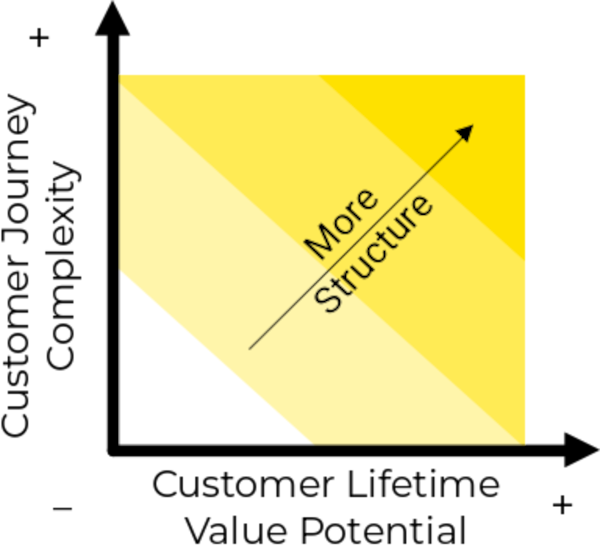
Businesses in the top-right quadrant — complex journeys with high lifetime value potential — benefit the most from applying a structured approach, as Revenue Architecture is.
Overlooked Truths About Growth (And What Revenue Architecture Reminds Us Of)
Most growth challenges don't come from lack of effort — they come from ignoring the fundamentals.
Here are a few truths that often get overlooked, and how thinking in Revenue Architecture terms helps bring them back into focus:
1. Acquire to Get the Attention — Retention and Growth Deliver the Returns
Many organizations are built to win customers — but not to keep and grow them. Resources skew heavily toward acquisition, while the real gains — loyalty, repeat business, and account expansion — remain underinvested.
Takeaway: Winning the customer is the starting line — not the finish line.
2. More Opportunities ≠ More Business
Piling more prospects into an unstructured process doesn't guarantee results. Without a designed system to guide opportunities from first contact to closed deal and beyond, progress leaks at every stage.
Takeaway: Volume can't fix a broken process.
3. Early Signals Matter More Than Late Results
Most businesses measure success after the fact — when deals close or contracts renew. But waiting for final outcomes leaves little time to adjust course.
Takeaway: By the time you see the outcomes, it's too late to influence it.
4. Heroes Don't Scale — Systems Do
Every business has standout performers. But relying on a few heroes isn't a strategy.
Takeaway: If your growth depends on individuals, your business can't scale.
5. Customer Lifetime Value is a Designed Outcome
High customer lifetime value isn't luck — it's the result of a deliberate, structured approach to delivering value over time.
Takeaway: Customer loyalty is built by design, not by accident.
Frameworks Are Just the Beginning
Revenue Architecture offers a strong foundation for designing growth systems that are intentional, structured, and sustainable.
It reminds us that real progress doesn't come from adding more activities — but from creating clear, repeatable paths that prioritize customer impact across the entire relationship.
At Pathway GTM, we value frameworks like Revenue Architecture for the discipline they bring — not as one-size-fits-all solutions, but as starting points for thoughtful design and adaptation.
We focus on aligning fundamentals — structure, consistency, and clarity — with the realities of each business we work with.
That's what guides our practice.
> Interested in discussing GTM challenges and specific situations? Let's talk.
> Explore how to extend your impact. We're expanding the network of practitioners who combine strategic thinking with execution excellence. Even with an established career, there are ways to collaborate on meaningful, high-impact projects that leverage your expertise in rewarding ways.
Beyond the Brief is Pathway's blog, where we dive into the nuances of N² (Nexus x Nerve), and explore real-world applications, practical execution insights, and strategies for navigating the complexities of modern B2B GTM.
Insight · CEO · CRO · Available Now